
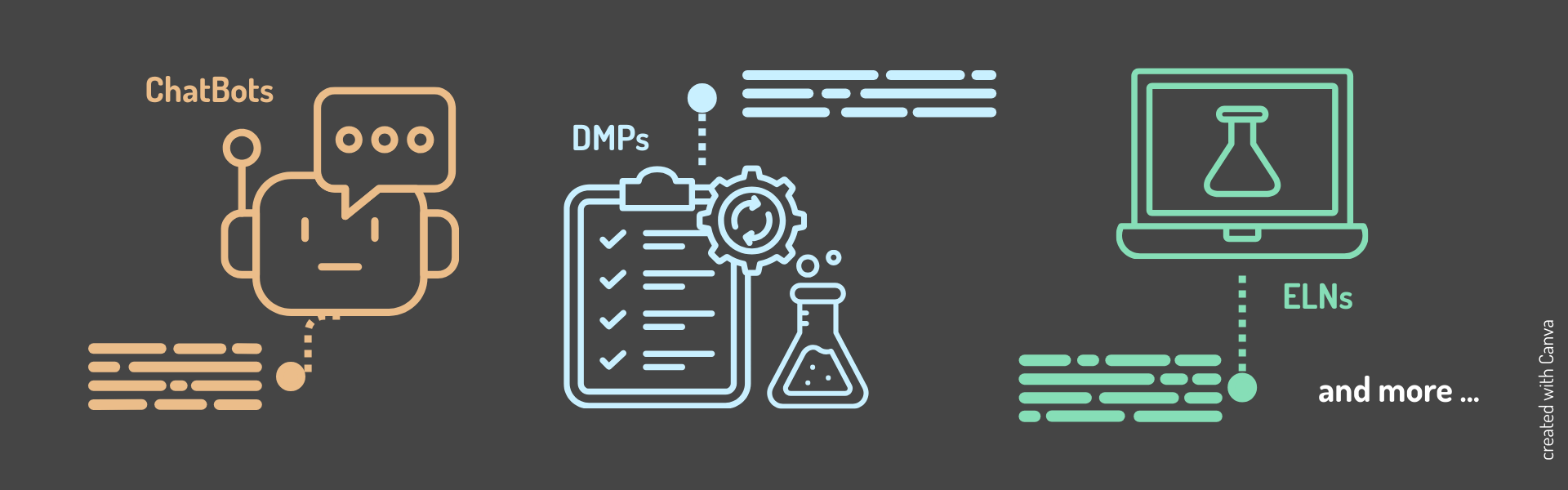
Welcome to this week’s News Digest. Each week, I explore the latest developments in research data management, focusing specifically on natural sciences, and provide a concise overview.
You can find the News Digest from past weeks here: https://thefairelephant.com/the-fair-elephant-blog/
And if you are looking for something specific, check out the News Digest Archive: https://thefairelephant.com/news_digest_archive/
Let’s dive right in!
NFDI4Cat
Introduction to PID4Cat
During the CoRDI meeting there was a panel discussing on persistent identifiers (PIDs) and the presentations are now available in Zenodo. Part of the publication are the slides to a five-minute input by David Linke on pid4cat. I flag this for everyone who is maybe not familiar with pid4cat. Here you have a nice and short overview. In the presentation, you also find the other contributions to the PID panel.
Link to presentation in Zenodo with DOI: 10.5281/zenodo.17817058
NFDI4Chem
Explaining basic RDM terms with chemistry-specific examples (video-series)
A new video-series was started by NFDI4Chem in which they explain basic terms from the field of research data management in a simple way using generic as well as chemistry-specific examples, currently the series is only available in German. The first three videos are on Repositories, Metadata and Electronic Lab Notebooks. The introductions into the topics are great to send to your researchers, but also very useful in workshops and lectures. In my opinion, the topics are explained nice and clear and with a length of 2–3 minutes, short enough to use them in many different contexts. Spread the word and share with your colleagues.
Check out the playlist below:
Chemistry-specific DMP checklist, RDMO and DMP4NFDI
If you haven’t had the chance to take a closer look at the chemistry-specific DFG checklist developed by NFDI4Chem or the software RDMO, then maybe now is your chance. NFDI4Chem uploaded the recording of their Stammtisch from June. In the recording, Ann-Christine Andres (NFDI4Chem) and Sabine Schönau (DMP4NFDI) are presenting the checklist as well as the integration in the Research Data Management Organiser (RDMO). So there are multiple reasons to check out this presentation: 1) You would like to learn more about the chemistry-specific adaptation of the DFG checklist 2) You need a brief introduction to RDMO 3) You are not sure what DMP4NFDI is and what they are doing. There are probably many more reasons, but I recommend it, if you need some of the basic information listed above.
NFDI4Earth
ChatBot for faster information retrieval
NFDI4Earth included a ChatBot, which can provide information from their Living Handbook as well as their website, into their OneStop4All access point. In a poster recently published in Zenodo they describe the architecture behind it and invite to the discussion on how such a ChatBot can lower the access barriers to specialized knowledge. What do you think? Is a ChatBot helpful to access information and would you like to seem them more? And do you maybe also know of other RDM related information points using ChatBots? Check out the ChatBot on https://onestop4all.nfdi4earth.de/.
Link to poster in Zenodo with DOI: 10.5281/zenodo.17708290
PSDI
Data sharing in organic chemistry
A few months back, I mentioned that PSDI had published an article where they investigated how much data is shared in the field of organic chemistry. And well, the result was not surprising, most researchers are not sharing their results, not even the very common NMR data. But why are researchers not sharing their results? What are the reasons, and how can we change this? These and more questions are addressed in a newly publish article on the PSDI webpage with one of the authors of the original paper, Dr. Sally Bloodworth. Highly recommended, quick read, big take away.
“Researchres aren’t resistant to change.”
“They’re just busy.”Dr. Sally Bloodworth
Link to article on the website of PSDI
Link to the original scientific article with DOI: 10.3762/bjoc.21.70
Data interoperability and electronic lab notebooks
Do you know what happened at the MADICES 3 workshop in October 2025? If you have no idea what the MADICES workshop are, and what they have to do with data interoperability in chemical sciences, then you should check out the presentation by Samantha Pearman-Kanza which provides information about the latest results of the community. Why data interoperability is a key factor in establishing electronic lab notebooks and what barriers and challenges are waiting for us. Check out the presentation and learn more about the community effort of MADICES. And as always with presentation by Samantha Pearman-Kanza (and PSDI in general) there is the right amount of humour with comics, but no Memes this time (I am shocked^^).
Link to presentation in Zenodo with DOI: 10.5281/zenodo.17790077
How to: community building and engagement
To successfully build a data infrastructure, you need to connect with the whole community that should profit from this infrastructure. Therefore, community building and engagement is one essential aspect on the way to a better data handling. In the presentation by PSDI they describe how they handle Community engagement and which services PSDI offer to support a better data handling. I very much like and support the introductory slide where you will find “Paper≠Bad”, “Electronic ≠Good” and “Tech ≠Transformation”. Just because something is digital, it is not automatically better, there is so much more to an ELN and the way to introduce it successfully. Highly recommended checking out the slides.
Link to presentation in Zendo with DOI: 10.5281/zenodo.17805765
From theory to practice: Introducing an ELN, an example
If you are a researcher or coordinator thinking about introducing an ELN or you are an ELN admin, then you should definitely check out the following presentation by Samantha Pearman-Kanza on the introduction of an ELN at the University of Southampton School of Chemistry and Chemical Engineering. It shows the process, trial design, barriers as well as breakthroughs in ELN implementation.
Link to presentation in Zenodo with DOI: 10.5281/zenodo.17792933
Electronic Lab Notebooks
Rspace
A new version of RSpace is available with some minor changes to the password policy as well as improvement on the documentation on how to use the Jupyter Notebook integration.
Link to changelog on the RSpace webpage
Software updates
NFDI4Chem & NFDI4Cat
nfdi-de/chem-dcat-ap: Release 0.1.0rc1
Link to release notes on GitHub
Link to software in Zenodo with DOI: 10.5281/zenodo.17806248
FAIRmat
Electronic Parsers v1.0.13 (plugin for NOMAD)
Link to release notes on GitHub
Link to software in Zenodo with DOI: 10.5281/zenodo.17834588
Outro
That’s it for today. Thank you for reading, and see you next week.
Benjamin